
Dua for Rain/Barish ki Dua in Arabic
Narrated Jabir ibn Abdullah:
The people came to the Prophet (ﷺ) weeping (due to drought). He said (making supplication):
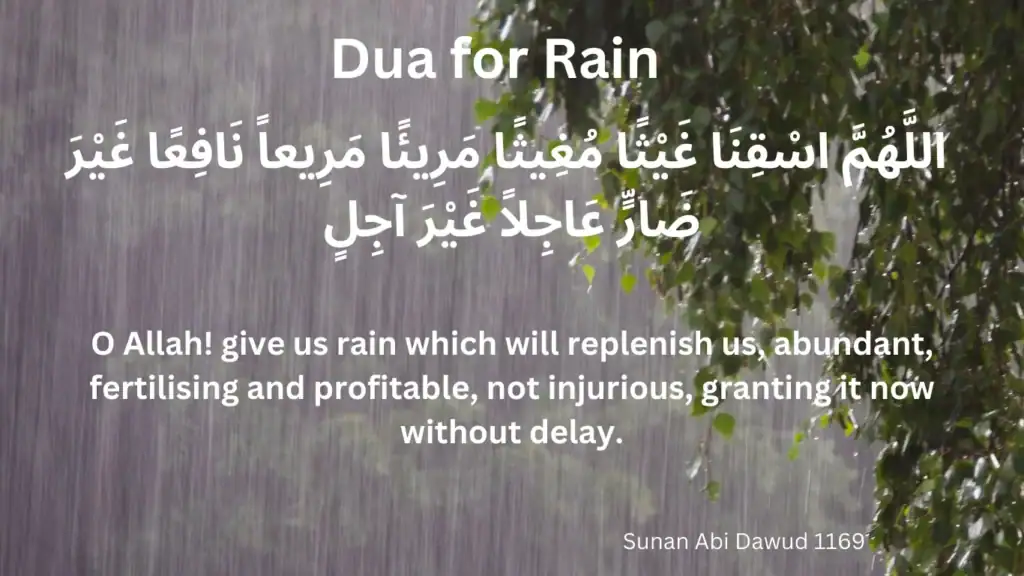
اللَّهُمَّ اسْقِنَا غَيْثًا مُغِيثًا مَرِيئًا مَرِيعاً نَافِعًا غَيْرَ ضَارٍّ عَاجِلاً غَيْرَ آجِلٍ
Allahumma asqina ghaithan mugheethan mareean maree’an naafi’an ghaira daarrin ‘aajilan ghaira aajil
He (the narrator) said: Thereupon the sky became overcast.
Reference: Sunan Abi Dawud 1169
Dua for Rain/Barish ki Dua in English
O Allah! give us rain which will replenish us, abundant, fertilizing, and profitable, not injurious, granting it now without delay.
Dua for rain/Barish ki Dua in Urdu
اے اللہ! ہمیں سیراب فرما، ایسی بارش سے جو ہماری فریاد رسی کرنے والی ہو، اچھے انجام والی ہو، سبزہ اگانے والی ہو، نفع بخش ہو، مضرت رساں نہ ہو، جلد آنے والی ہو، تاخیر سے نہ آنے والی ہو

How to perform the Istisqa prayer (Namaz e Istisqa ka tarika)
The Istisqa prayer, also known as Salat al Istisqa, is a specific supplication performed by Muslims for the purpose of asking Allah solely for rain during severe water shortages and protracted droughts. This prayer is offered collectively in an apparent location and is typically led by an imam or another religious figure.
Interesting Fact: Rain in Islamic History
During the time of Caliph Umar ibn Al-Khattab, a severe drought hit Madinah. He led the Muslims out in collective Istisqa prayer, and historical accounts say rain fell that same day. This event is often cited as one of the earliest recorded examples of the Istisqa prayer being answered, and it remains a reference point for scholars discussing the power of collective dua in Islamic tradition.
Sunnah During Rain
In the rainy season, there are several sunnah practices that Prophet Muhammad recommended and encouraged the Muslim community to follow. Here are some sunnah actions to observe during rain.
Ask Allah to Make the Rain Beneficial
Show gratitude to Allah for bringing rain. The Prophet Muhammad would often say, “Allahumma Sayyiban Nafi’a” (O Allah, make it a beneficial rain) after seeing rain.
Standing Under the Rain
Standing in the rain and exposing some of your body to rain is the sunnah practice of Prophet Muhammad.
Hazrat Anas report it,
“It rained on us while we were with the Prophet of Allah(ﷺ). The Prophet of Allah (peace be upon him) removed his cloth from a portion of his body until rain fell upon it. We questioned the Prophet of Allah, “Why did you do that?” He explained: “It is because it (rain) is coming straight from Exalted Lord.” (Sahih Muslim 898)
Pray to Allah
Raining is the best time to make dua, as Sahl ibn Saad reports that the Prophet Muhammad(ﷺ) said:
Two (prayers) are not rejected or seldom rejected: Prayer at the time of the call to prayer and (the prayer) at the time of fighting when the people grapple with each other. Musa said: Rizq ibn Sa’id ibn AbdurRahman reported from AbuHazim on the authority of Sahl ibn Sa’d from the Prophet (ﷺ) as saying: And while it is raining. (Sunan Abi Dawud 2540)
ALSO READ: Dua after Azan/Azan kay Baad ki Dua
Benefits of Dua for Rain/Barish ki Dua ki Fazilat
The practice of making dua for rain(barish ki dua) has an important place in Islam. It is a sunnah practice of the Prophet(ﷺ), who advised believers to seek Allah’s blessings when they experience rain. Rain is considered to be a gift from Allah. Making a dua for rain is a chance to thank Allah for this blessing and also acknowledge Allah’s mercy.
Making a dua rain can help increase one’s spiritual connection to Allah and make believers aware of the power of Allah. Rain is also considered to be a sign of Allah’s forgiveness. A lot of people take advantage of this time to ask for forgiveness for their mistakes and sins.
FAQs
Is dua accepted during rainfall?
Yes, according to a hadith in Sunan Abi Dawud, the time during rainfall is one of the times when dua is rarely rejected. This makes rain a recommended time for Muslims to ask Allah for forgiveness and blessings.
Is it necessary to make dua after every rainfall?
Making dua after rain is a recommended practice but not obligatory. It is a virtuous act which shows love and gratitude to Allah.
Is there a particular time or day when it is recommended to recite the dua for rain?
There’s no specific day or time that is designated to recite the dua for rain. The dua can be recited whenever the need arises, such as during droughts or when a community faces a water shortage.
Does the dua for rain guarantee rain?
Reciting the dua to pray for rain is a type of supplication, and its effectiveness is ultimately the decision of Allah. Although it’s a method to seek Allah’s blessing, it is not a guarantee of rain.